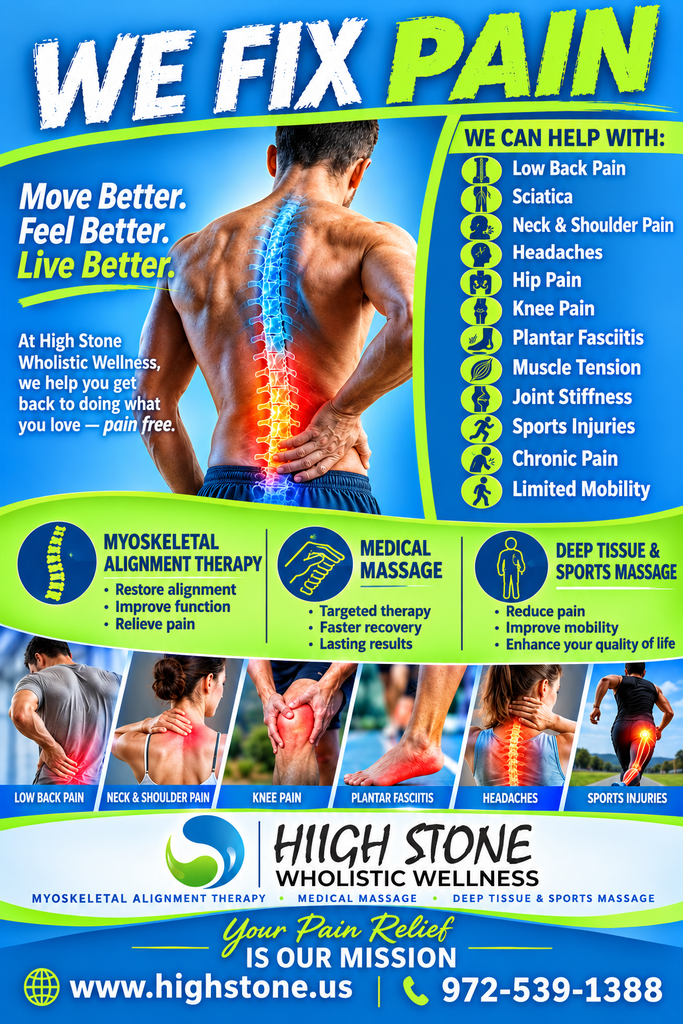
Medical Massage: Targeted Pain Relief for the Way Your Body Moves
Living with pain can affect almost everything you do—from getting out of bed in the morning to working, exercising, sleeping, or simply enjoying time with your family. Whether your pain is in your back, neck, shoulders, hips, legs, or feet, you may have tried stretching, medications, or traditional massage and still feel like something is missing.
Medical Massage takes a more focused approach.
Instead of providing a routine full-body massage, Medical Massage is designed around your specific pain patterns, muscular restrictions, movement limitations, and individual needs. The goal is to identify areas that may be contributing to your discomfort and apply targeted hands-on techniques to help improve mobility, reduce muscular tension, and support your body’s natural ability to function.
What Is Medical Massage?
Medical Massage is a therapeutic form of massage that focuses on specific areas of the body rather than simply providing general relaxation. Your session may incorporate techniques such as myofascial release, trigger-point work, deep tissue techniques, stretching, positional techniques, and other therapeutic approaches.
Depending on your needs, treatment may focus on problems involving the:
- Lower back and hips
- Neck and shoulders
- Upper and lower legs
- Knees
- Feet and plantar fascia
- Muscles and connective tissues
- Areas affected by repetitive use or muscular tension
- Postural and movement-related discomfort
Research has found that massage therapy may provide short-term relief for several types of pain, including some forms of low-back, neck, shoulder, and osteoarthritis-related pain.
Your Pain Isn’t Just “One Spot”
One of the most important principles of therapeutic bodywork is that the area where you feel pain isn’t always the only area that needs attention.
For example, discomfort around the shoulder may be influenced by tension in surrounding muscles or restrictions involving the neck and upper back. Foot pain may be affected by muscular tension and movement patterns throughout the lower leg. Lower-back discomfort may involve the hips, pelvis, and surrounding soft tissues.
That’s why I don’t believe in a one-size-fits-all massage.
I take time to understand where you hurt, how you move, what activities aggravate your symptoms, and what your body is telling us. Your treatment can then be focused on the areas that may need the most attention.
Meet John Thompson, LMT
I’m John Thompson, LMT, and my approach to massage therapy has developed far beyond traditional relaxation massage.
My education and training include an Associate Certificate in Osteopathy from the London College of Osteopathy, training in Myoskeletal Alignment Technique, and specialized education in Medical Massage, including my Medical Massage Practitioner (MMP) Certification.
My goal is simple: to provide therapeutic, results-oriented bodywork for people who are looking for more than a typical spa massage.
I combine my knowledge of massage, myofascial techniques, myoskeletal concepts, and osteopathic principles to create a treatment approach based on the individual in front of me.
Ready to Take the Next Step?
If pain, stiffness, muscular tension, or restricted movement is interfering with the things you enjoy, you don’t have to simply learn to live with it.
Medical Massage may be a valuable part of your overall approach to managing pain and improving movement.
Let’s identify what’s bothering you and develop a hands-on treatment approach specifically for your needs.
Schedule your Medical Massage with John Thompson, LMT, and take the first step toward moving, feeling, and functioning better.
Medical Massage is complementary care and is not intended to diagnose, treat, or cure medical conditions. If you have a new, severe, or unexplained medical problem, consult an appropriate healthcare professional.have a new, severe, or unexplained medical problem, consult an appropriate healthcare professional.